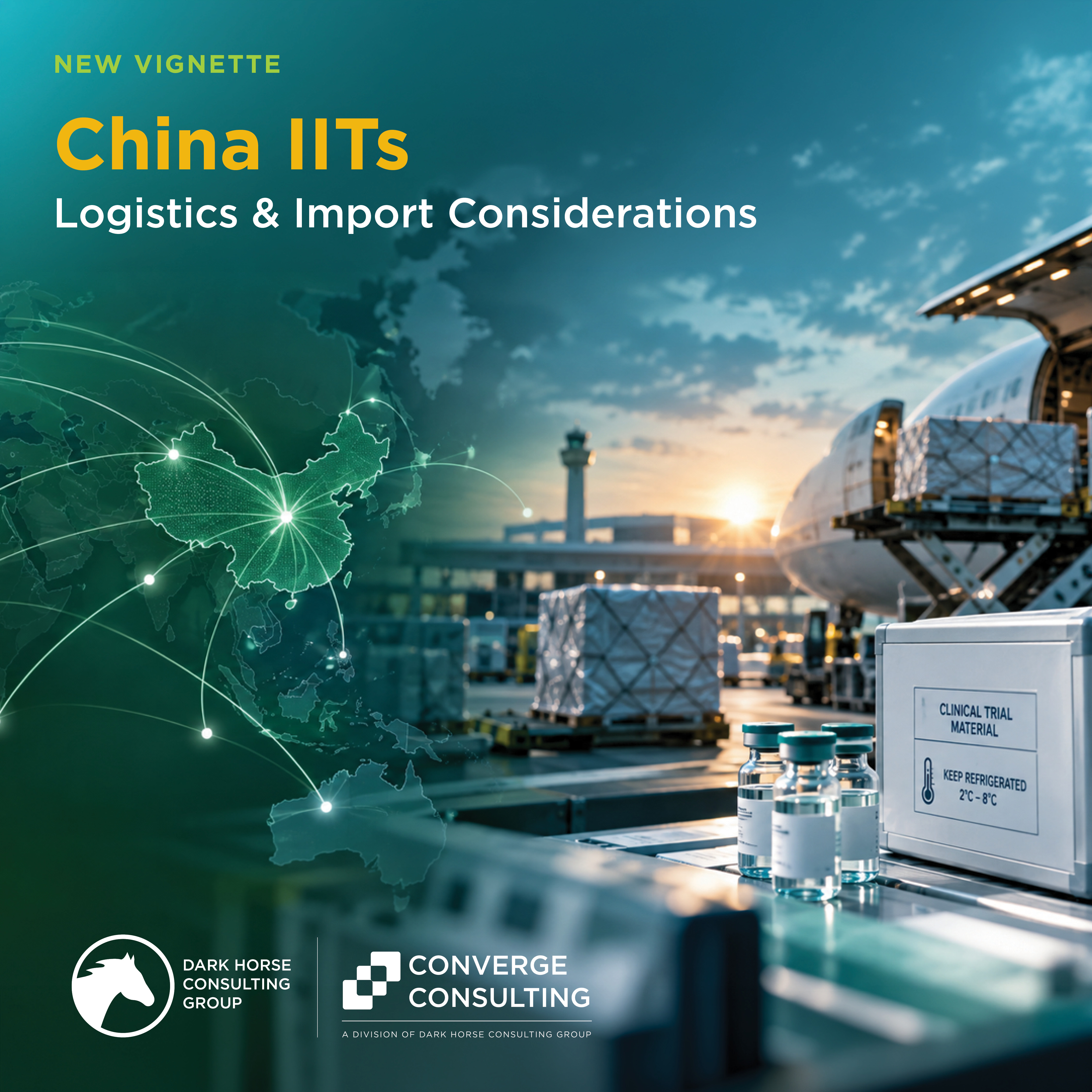
中国におけるIIT物流と輸入に関する留意事項

IIT Vignette

Download the vignette here

‍

‍China IITs Are Unique and Operationally Challenging Across the Clinical Supply Chain

Understanding the clinical supply chain, logistics, and import framework for Investigator Initiated Trials (IITs) in China is critical for biopharma companies seeking to leverage the country’s speed and cost advantages in early clinical development. While China offers compelling benefits to clinical development, supply chain and importation processes differ significantly from Western markets due to a high level of scrutiny on investigational materials, fragmented regulatory oversight, direct to hospital/site distribution and inventory models, and evolving customs and importation enforcement practices.

Unlike in the U.S. and Europe, where clinical trial approval generally enables importation of cGMP drug product (DP) finished good investigational materials (IMP), China treats importation as a separate regulatory and compliance process. Chinese Customs (GACC) acts as a gatekeeper and will not release shipments unless documentation is complete, consistent, and aligned with the declared clinical purpose. Shipments are often held at port until all requirements are satisfied, increasing the risk of IIT timeline delays and operational disruptions, with potential loss of valuable clinical material.

Recent trends indicate that Chinese Customs authorities have become less flexible, particularly for clinical trial materials imported from outside China. Furthermore, for advanced therapies (e.g., cell and gene therapy), there is growing pressure to align import timing with patient-specific informed consent, adding complexity to supply chain planning.

Expertise and Partnership Are Essential

Many sponsors, particularly those new to China IIT processes, underestimate the complexity of both the clinical execution model and the physical logistics importation process of DP finished goods/investigational materials. In practice, successful execution requires tight coordination between sponsors, CROs, hospitals/sites, logistics providers, and local regulatory experts.

For example, advanced therapy companies have recently encountered various investigational material import situations where:

  • Chinese Customs required additional documentation proving intended clinical use and drug origin
  • Hospitals/sites declined to act as Importer of Record due to licensing, tax, liability, and limited global trade compliance capability concerns
  • CROs had strong clinical capabilities but lacked experience navigating import requirements

In these cases, delays were often driven not by a single missing document, but by misalignment across regulatory, clinical, customs, hospital/site, and logistics stakeholders.

However, operational trade-offs remain. While sponsors often prefer to import larger batches for efficiency, evolving expectations, particularly for advanced therapies such as cell and gene therapy (CGT), may require patient-specific importation tied to informed consent, placing international shipping directly on the treatment administration critical path.

As sponsors evaluate China IIT strategies, these evolving operational realities highlight that execution risk extends well beyond clinical study design. Regulatory uncertainty, import requirements, and partner capabilities increasingly influence study feasibility, timelines, and overall program success.

Challenges and Risks

  • Regulatory ambiguity
    IITs have historically operated in a legal gray zone and do not fit neatly within China’s traditional product-focused regulatory framework, which was primarily designed around industry-sponsored registration trials. However, China recently introduced the Regulations on the Administration of Clinical Research and Translational Application of New Biomedical Technologies (State Council Decree No. 818), establishing a more formal national framework for the clinical research and translational application of new biomedical technologies, including advanced therapies such as CGT. While the regulation provides greater structure and oversight for IITs and translational medicine activities, practical implementation, impact, and interpretation across logistics and importation continue to evolve.
  • Import complexity
    Documentation and Importer of Record (IOR) requirements are extensive and inconsistently applied; customs clearance is not guaranteed even with preparation.
  • Operational and clinical supply chain dependency on local partners
    CROs, logistics providers, and hospitals/sites play critical roles but may have varied levels of experience with China IITs.
  • Supply chain constraints
    Cold chain management, labeling, and chain-of-custody requirements are tightly enforced and subject to inspection.
  • Timing challenges

Potential requirements to align import timing with patient consent may reduce flexibility and increase execution risk.

  • Compliance risks
    Lack of clear accountability within IITs increases exposure to misuse or regulatory non-compliance.

What to Do

Realizing the speed and cost advantages of China IITs requires sponsors to address supply chain, importation, and logistics considerations early and integrate them into the broader clinical execution strategy. Importation should not be treated as a downstream activity; decisions regarding import pathways, local partner roles, documentation, product handling, and contingency planning can directly affect China IIT study feasibility and timelines.

Particular attention should be given to local partner capabilities, import readiness, and for advanced therapies, the impact of patient-specific requirements on shipment and treatment timing. Leading practices include:

  • Plan early and cross-functionally
    Align Clinical, Regulatory, Quality, and Supply Chain/Logistics teams at the outset of China IIT planning. Define roles, responsibilities, dependencies, and decision points across the sponsor, CRO, hospital/site, customs broker, and logistics provider to identify gaps early and avoid downstream delays.
  • Treat China importation as a critical path activity
    Develop the import strategy in parallel with clinical study planning and confirm requirements well before IMP shipment. This includes product classification, documentation, labeling, consignee and Importer of Record responsibilities, and customs clearance requirements. Incorporate realistic import and clearance timelines into the overall study plan.
  • Qualify local partners for IIT-specific capabilities
    Select CROs, customs brokers, and logistics providers based on demonstrated China IIT and GACC experience and not simply general clinical experience in China. For CGT and advanced therapies, confirm capabilities for cold chain management, chain of custody, product handling, and time-sensitive logistics.
  • Establish clear Importer of Record and consignee responsibilities
    Determine early which entity is able and willing to perform required import and consignee functions. Hospitals/sites may be reluctant to assume these responsibilities because of licensing, tax, liability, systems, or import capability concerns, making early alignment essential to avoiding late changes to the import model.
  • Use established and fit-for-purpose China import pathways
    Evaluate ports of entry, customs clearance routes, local warehousing, and Free Trade Zone (FTZ) strategies based on the investigational material and study requirements. Where appropriate, consider established gateways/ports of entry such as Shanghai or Beijing and confirm that the selected pathway can support required cold chain or advanced therapy handling.
  • Strengthen documentation, traceability, and shipment readiness
    Ensure consistency across customs documentation, product information, clinical protocols, labeling, chain of custody, temperature control records, and declared clinical use. Conduct a coordinated pre-shipment review to identify gaps or inconsistencies before material departs the country of origin.
  • Build contingency plans for CGT logistics
    For cell and gene therapies and other time- or temperature-sensitive products, plan for customs delays, patient-specific import requirements, temperature excursions, shipment disruptions, and treatment schedule changes. Where importation is tied to patient consent or treatment, map shipment and customs clearance activities directly against the clinical schedule.
  • Monitor evolving regulatory and customs expectations
    Maintain active communication with local China regulatory, customs, and logistics experts throughout study planning and execution. Assess evolving requirements for potential impacts on documentation, import strategy, shipment timing, and overall study execution.

Final Perspective


China IITs can provide substantial strategic value for sponsors seeking accelerated development timelines for advanced therapies, earlier clinical insight, and more efficient generation of proof-of-concept data. However, realizing these benefits requires a level of operational coordination, regulatory preparation, and logistics & supply chain planning that many sponsors may initially underestimate.

Success depends on treating China IIT execution as an integrated clinical, regulatory, and logistics & supply chain strategy rather than solely as a clinical opportunity. Sponsors that plan early, establish clear accountability across local and global stakeholders, and proactively address importation and logistics & supply chain requirements will be better positioned to preserve the speed and cost advantages of the China IIT model while minimizing execution risk and avoiding preventable delays.

‍

Related Posts

最新情報を受け取る

Dark Horse Consulting Groupのメーリングリストに登録して、先端医療の開発、規制の最新情報、業界トレンド、今後のイベントに関する最新の知見を受け取りましょう。

ありがとうございます。送信が完了しました。
申し訳ございません。フォームの送信中にエラーが発生しました。

プライバシーを尊重します。いつでも登録解除が可能です。お客様の情報を第三者に販売することはありません。