A Q&A with Dark Horse Consultant Subject Matter Experts
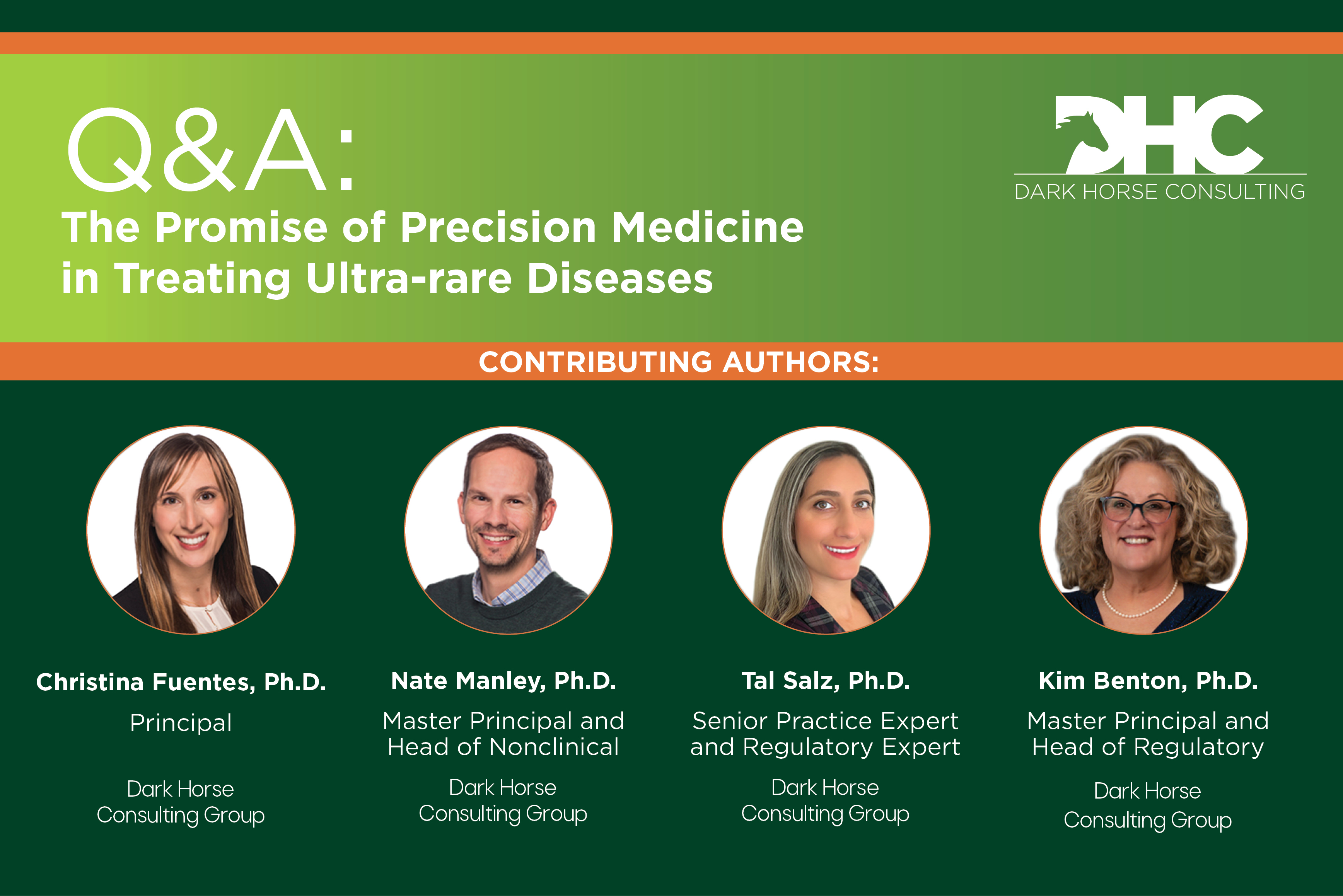
Authors:
Christina Fuentes, Ph.D., Principal, Dark Horse Consulting Group - CGT bioengineer with cutting-edge expertise in AAV-mediated gene editing
Kim Benton, Ph.D., DHC Master Principal and Head of Regulatory, former FDA leader with industry leading regulatory strategy expertise
Nate Manley, Ph.D., DHC Master Principal and Head of Nonclinical - CGT industry veteran with deep subject matter experience in nonclinical and analytical development strategy
Tal Salz, Ph.D., DHC Senior Practice Expert & Regulatory Expert, ex-FDA reviewer & subject matter expert in CMC and comparability
Q: Christina, what is precision medicine and why talk about it now for ultra-rare diseases?
A: Christina: Precision medicine refers to the development of targeted therapies based on a patient’s genetic profile and other unique characteristics. Many rare diseases are genetic in origin, and as a result, cell and gene therapy developers are playing an increasingly important role in creating innovative and precise therapies where few or no options previously existed.
In regard to “why now?”, this moment feels like a convergence of several important forces.
First, the technological advances — particularly in cell and gene therapy and gene editing — have reached a point where we can realistically think about treating the underlying genetic causes of disease, not just managing symptoms. That shift fundamentally changes what’s possible.
Second, we now have real clinical proof points. High-profile examples like the treatment of Baby KJ demonstrated that truly precise, N-of-1 therapies are not just theoretical; they can be developed, manufactured, and delivered under extremely compressed timelines when the right expertise and collaboration are in place.
Third, the field itself is maturing. We now have dozens of approved cell and gene therapies, along with a growing body of institutional knowledge around how to develop, manufacture, and regulate them. That maturity gives us something to build on.
Patient advocacy has become another major driving force. Parents, families, and nonprofit groups are increasingly driving therapies forward for ultra-rare diseases where the genetic cause may be known, but few or no treatment options exist. They are identifying patients globally, raising funds, and pushing promising science out of academic labs and toward real-world impact. All told, this is the right time to be talking seriously about the promise, and the realities, of precision medicine.
I’d also like to note that ultra-rare patients are no less deserving of treatment simply because their numbers are small. The maturity of the field now allows us to seriously consider how to extend advanced therapies to these populations even when the traditional commercial model doesn’t fit.
Q: What do we mean by ultra-rare disease vs. N-of-1 therapies?
A: Christina: These terms are often used together, but they’re not interchangeable.
Ultra-rare refers to diseases that affect an extremely small number of patients, generally regarded as conditions affecting <1 in 50,000 people. In some cases, there may be only a few hundred known worldwide, or even fewer. In practice, these are conditions where traditional development models simply don’t apply. In other words, ultra-rare is a term used to describe the prevalence of a disease.
N-of-1 therapies can mean a few different things. In one scenario, a sponsor intentionally develops a novel or customized therapy to treat a single, named patient—often an individual with a unique genetic mutation and a rapidly closing treatment window — under what is known as a “single patient IND,” often submitted to FDA by a sponsor-investigator. In another scenario, N-of-1 can refer to emergency or compassionate use of an existing therapy, applied off-label to a single patient in urgent need. The latter is inclusive of investigational products that have an open IND where the therapy is being extended to a patient who does not meet the study's inclusion/exclusion criteria. In other words, the concept of N-of-1 therapies refers to the clinical trial strategy focused on treating a single individual and can be inclusive of patients who have an ultra-rare disease.
Q: What unique challenges do ultra-rare and N-of-1 therapies pose beyond “standard” CGT development?
A: Christina: All the usual challenges of cell and gene therapy development still apply (time, cost, CMC complexity, and regulatory uncertainty), but they’re amplified and, in some cases, accelerated by several additional factors.
Sponsors and consultants often find themselves needing to make critical decisions with less information and even fewer precedents. There may be limited preclinical data, limited manufacturing experience with a specific construct, and very little room to iterate.
Timelines are often driven by the health of a specific patient whose disease may be rapidly progressing. Instead of planning for a future commercial cohort, you’re racing against the biology of one individual.
Funding is another major constraint. Many sponsors in this space are small nonprofits or family-led organizations operating with limited budgets. And layered on top of this is the emotional weight — the knowledge that every decision directly affects a real person, often a child, right now.
Q: How do timelines and decision-making change in N-of-1 development?
A: Christina: In traditional development, you might spend months deciding on a manufacturing plan, including running RFPs, visiting CDMO sites, and carefully evaluating partners. In an N-of-1 scenario, you don’t typically have that luxury.
Decisions must be made quickly, which means relying heavily on prior experience, trusted networks, and partners who have worked in ultra-rare or personalized settings before. Compressed timelines inherently increase risk: not because teams are careless, but because there’s simply less time to de-risk every unknown.
In many ways, you plan backwards from the patient’s anticipated treatment window rather than forwards from a standard development plan. That inversion fundamentally changes how you think about priorities, acceptable uncertainty, and what “good enough” means in a given context.
Q: Nate, as Head of Nonclinical at DHC, talk to us about what nonclinical and IND roadmap issues are specific to ultra-rare and N-of-1 therapies.
A: Nate: Just as when developing therapies for large patient populations, nonclinical studies for ultra-rare and N-of-1 therapies must first and foremost indicate that the investigational product is expected to be safe. The nonclinical studies required to demonstrate product safety can vary widely, primarily driven by the biological intersection of the clinical indication – i.e., the anatomical and pathophysiological elements of the disease state – and the investigational therapy – i.e., its physical composition and functional properties. Another major factor that determines the scope of the nonclinical safety package is the degree of novelty built into the therapeutic product.
Are there components of the product’s design that have never been tested in humans? Greater complexity or novelty increases the potential for a more comprehensive nonclinical safety package. In the context of ultra-rare and N-of-1 therapies, some degree of product complexity and novelty may be necessary to overcome the limitations of past approaches (or the lack thereof), but they also can oppose a need to move swiftly and cost-effectively to IND. Therefore, aiming for the appropriate balance of design precedent versus novelty can enable sponsors to leverage prior nonclinical or clinical data from related therapies and reduce the extent of de novo nonclinical safety testing. In other words, design a product that is fit for purpose, but try not to over-engineer.
Another consideration for certain types of advanced therapies (consider permanently engrafting cell therapies or gene therapies capable of genome integration as an example) is whether long-term nonclinical toxicology studies are needed. If so, this can pose a challenge for ultra-rare or N-of-1 therapies that aim to treat rapidly progressing diseases. Here again, leveraging prior data from related therapies can help reduce the nonclinical safety testing burden. Even more important is engaging in early dialogue with the relevant health authorities to discuss the product’s perceived risk:benefit analysis and whether a reduced nonclinical safety package can be justified on the basis of disease severity and/or urgency.
While demonstration of product safety is paramount for enabling clinical translation, there also must be evidence that the investigational product has the potential to provide meaningful therapeutic benefit to the intended patient(s). For ultra-rare or N-of-1 therapies, a streamlined nonclinical pharmacology package may rely more heavily on in vitro modeling: for example, studies utilizing the disease-relevant, patient-derived cells, if available. Alternatively, a literature-based, scientific argument relating the product’s hypothesized mechanism of action to the indication’s underlying biology in some cases can be sufficient, however this depends not only on the complexity/novelty considerations mentioned above, but also upon whether there are relevant nonclinical models that enable efficacy testing with the intended clinical product. In the case of some genetic diseases, species differences may make animal models irrelevant for studying a product’s therapeutic mechanism and therefore preclude the need for in vivo pharmacology studies. As with the nonclinical safety package, presenting the nonclinical pharmacology plan to regulators early on in product development, ideally with some pilot proof-of-concept efficacy data in-hand, can help ensure that only must-have studies are included on the roadmap to clinic.
Overall, designing a streamlined, time efficient, and cost-effective nonclinical plan for ultra-rare diseases and N-of-one therapies is achievable. Leveraging existing data from related products, focusing de novo studies on the product’s novelty features, and seeking early regulatory buy-in (i.e., via an INTERACT or Scientific Advice meeting) on the overall nonclinical development strategy are key to building a pragmatic, defensible roadmap that appropriately balances speed, safety, and scientific rigor.
Q: How are manufacturers adapting to support ultra-rare therapies?
A: Christina: We’re seeing CDMOs evolve in meaningful ways. One important trend is the development of platform processes — baseline, well-understood manufacturing approaches for certain vector or cell types that can be tailored for individual products rather than building a complete process from scratch every time.
While every therapy still has unique aspects, starting from a proven platform can save time and reduce uncertainty. Internally, manufacturers also accumulate knowledge across multiple programs, which allows them to improve processes and offerings over time, even when they can’t directly share specifics between clients.
Some CDMOs are clearly developing recognizable experience in ultra-rare and N-of-1 work. While these programs may not be their largest revenue drivers, they contribute to advancing the field and demonstrating what’s possible.
Additionally, Sponsors may consider utilizing existing CMC processes and packages for similar products to help accelerate their program. From a regulatory application perspective, this could mean cross-referencing other INDs for which CMC information can be leveraged. The Agency has similarly been moving towards efforts to help accelerate and streamline the development of cell and gene therapies with programs such as FDA’s Platform Technology Designation. A key consideration for Platform Technology Designation is that the technology must be incorporated in or used by an approved drug or biological product. This means the merits of this program may be limited for some technologies where approval is still years away.
Q: Kim and Tal, you’re both former FDA’ers. Given your significant regulatory expertise, please help us understand what the regulatory path for precision medicine/ultra-rare diseases might look like.
A: Kim: The regulatory path can start with a single-patient IND, often submitted by a sponsor-investigator for the purpose of treating one individual. Unfortunately, that is where the path has too often ended because therapies for ultra-rare diseases have been considered commercially non-viable and the regulatory path to approval too burdensome. In the US, all biologics and drugs are subject to the same IND regulations for clinical trials and BLA/NDA regulations for marketing approval. However, FDA can apply regulatory flexibility as appropriate. The challenge for both regulators and product developers is how to define and apply regulatory flexibility.
For example, early-on flexibility and decisions made to help accelerate a product into the clinic may limit how much can be leveraged for BLA filing, causing a major hurdle to advancement. In traditional development, a phase-appropriate approach to product development is made where additional controls and measures are put into place as the clinical program advances, from gathering clinical data to demonstrate safety to gathering evidence of efficacy. This becomes a particular challenge in the ultra-rare space where the population size is small, so all the available patient data is needed to demonstrate safety and efficacy for licensure. Unfortunately, the corresponding CMC requirements needed when collecting clinical data to demonstrate efficacy for licensure are often a much higher bar than what’s needed to get into the clinic to demonstrate product safety. This is where we see Sponsors sometimes feeling that there is a mismatch in understanding regarding introducing flexibility in the ultra-rare space. That’s why it is critical to understand how decisions made early on have potential implications for downstream development.
There are growing efforts by multiple stakeholders to bridge that gap and define a path to BLA approval for precision medicine products including cell and gene therapies. One example of stakeholder efforts is the NCATS Somatic Cell Gene Editing Consortium’s support of development of gene editing platforms that led to the treatment of Baby KJ in 2025. FDA has previously discussed platforms for CGT in multiple public forums, provided an update on flexible requirements for CGT on its website, and has published a draft guidance on the concept of a Plausible Mechanism framework in February of this year.
A: Tal: FDA recognizes the importance of the approval of safe and effective individualized therapies. The recent draft guidance titled “Considerations for the use of the Plausible Mechanism Framework to Develop Individualized Therapies that Target Specific Genetic Conditions with Known Biological Cause” defines individualized therapies as biologics that target a specific pathophysiologic abnormality serving as the root cause of a disease, and for which clinical evidence from a limited number of patients will be available to support the individualized product’s safety or efficacy in the intended patient population. The guidance provides considerations for developers of individualized biological therapies based on a plausible mechanism framework with a focus on genome editing (GE) and RNA-based therapies such as antisense oligonucleotides (ASOs). By building in some regulatory flexibility, the FDA hopes to broaden access to these treatments and fuel continued scientific progress across the rare disease space. However, how much risk the agency is willing to accept will come down to the benefit:risk balance evaluated during review.
The guidance discusses preclinical, clinical, and CMC flexibilities for such therapies to support licensure under existing regulatory approval pathways. From a CMC perspective, the main issue is that there is often very limited clinical manufacturing experience for these therapies, and all clinical data obtained would be vital to support safety and efficacy for licensure, which means CMC needs to be at its best with the first dosed patient. Components like gRNAs and oligos may need to be deliberately varied to target patient-specific mutations, which is essential for building clinical experience across a disease population. Lastly, potency assays would need to be designed as a mutation-specific assay that can be adapted to address different mutations, which may be a burdensome approach.
One meaningful example of regulatory flexibility and an opportunity to leverage data is the development of different gRNAs targeting different mutations in a single gene mentioned above. In this example, multiple product “variants” incorporating these gRNAs may be included in a single IND/BLA if the method of correction is the same between the gRNA (e.g., return to the normal/native gene sequence). Under this paradigm, nonclinical and clinical data could be collected using a defined set of mutations to support product licensure. FDA further states that a well-supported “plausible” mechanism of action may then be used to justify adding new GE product variants, intended to treat patients with mutations that were not included in the clinical trial used to support the original approval.
That said, FDA is clear that the core regulatory requirements remain in place. GE products still need a robust control strategy which includes evaluation of on-and off-target editing in the case of GE products, method and process validation, stability, potency assay, and full CGMP compliance. It remains to be seen how regulatory flexibility will play out in practice and whether it would be sufficient to make developing individualized therapies under existing approval pathways a realistic path forward for sponsors.
Q: You’ve mentioned patient advocacy groups and nonprofit Sponsors. What role do they play?
A: Christina: They are often the true drivers of these programs. Patient advocacy groups and parent-led organizations are identifying affected individuals across the globe, building communities, raising funds, and pushing promising academic discoveries toward the clinic.
While these groups may not have deep in-house development expertise, they bring extraordinary commitment and urgency. They are highly motivated to assemble the right experts and make informed decisions under very real constraints. As consultants, it’s incredibly powerful to work alongside that level of passion and purpose.
Q: Closing perspective: what does the promise of personalized medicine really mean?
A: Christina: Precision medicine for ultra-rare (including N-of-1) diseases represents the next level of complexity built on top of an already challenging field. It pushes us to rethink timelines, risk, collaboration, and success itself.
What’s become clear is that this work truly takes a village, with families, advocacy groups, academics, manufacturers, consultants, and regulators all working together under extraordinary constraints. When it works, the impact extends far beyond a single patient. Each success creates knowledge, precedent, and momentum that can open doors for the next child, the next family, and the next disease.
That is the promise of precision medicine — not just individualized treatment, but a new way of advancing therapies for those who have historically had the fewest options.
Subscribe to our mailing list for the latest insights on advanced therapy development, regulatory updates, industry trends, and upcoming events from Dark Horse Consulting Group.
We respect your privacy. Unsubscribe at any time. We will never sell your information.